Enquiries +91 97699 99960 im@digantsharma.com

Journey

The Path
Forward

Seven chapters, in order: an engineering education across two countries, an early turn toward property, a company founded in a falling market, and a succession arranged in the founder’s own lifetime.

Span

Baghdad → Cranfield → Bradford → Dubai

Only documented stages appear below. Where a precise date is not on the public record, the stage is placed by its described period instead.

I

Baghdad

An electrical engineering degree, and a national ranking

The first documented stage is academic. Hussain Binghatti Aljbori read electrical engineering at the University of Baghdad, completing the degree among the top three highest academic achievers at national level.

Electrical engineering is a foundational discipline rather than a vocational one: circuits, signals, power, and the mathematics that describes them. It establishes a habit of treating a problem as something to be modelled before it is built.
II

Cranfield, UK

A master’s in digital control engineering

He continued his studies in the United Kingdom, taking a master’s degree in digital control engineering at the Cranfield Institute of Technology.

Control engineering is the discipline of keeping a system on target while the world pushes it off course. It is concerned with feedback, stability and the behaviour of a process under disturbance — how far a system deviates, how quickly it recovers, and whether it recovers at all.

III

Bradford, UK

A doctorate in industrial technology engineering

The third qualification is a PhD in industrial technology engineering from the University of Bradford — the doctorate behind the title by which he is usually identified.

Where control engineering studies a single system under stress, industrial technology engineering concerns production: how output is organised, measured and held to a standard as volume increases. Between them, the two degrees describe the two problems a large developer must solve at once.

IV

Early twenties

The turn toward real estate

Binghatti records that he began moving toward the real estate sector in his early twenties. It is the pivot on which everything after it rests, and it happened long before there was a company to attach it to — the interval between that turn and the founding of Binghatti in 2008 is measured in decades, not years.

That gap is worth stating plainly, because it contradicts the usual founder narrative. Binghatti was not a young man’s first venture. It was established by someone who had already spent a working lifetime in and around the sector, and who had three engineering qualifications behind him before he started.

2008 · Dubai

Binghatti is founded

The company takes the name of his late father, Ghatti Bin Ghaeb, chosen so the brand would carry across generations.

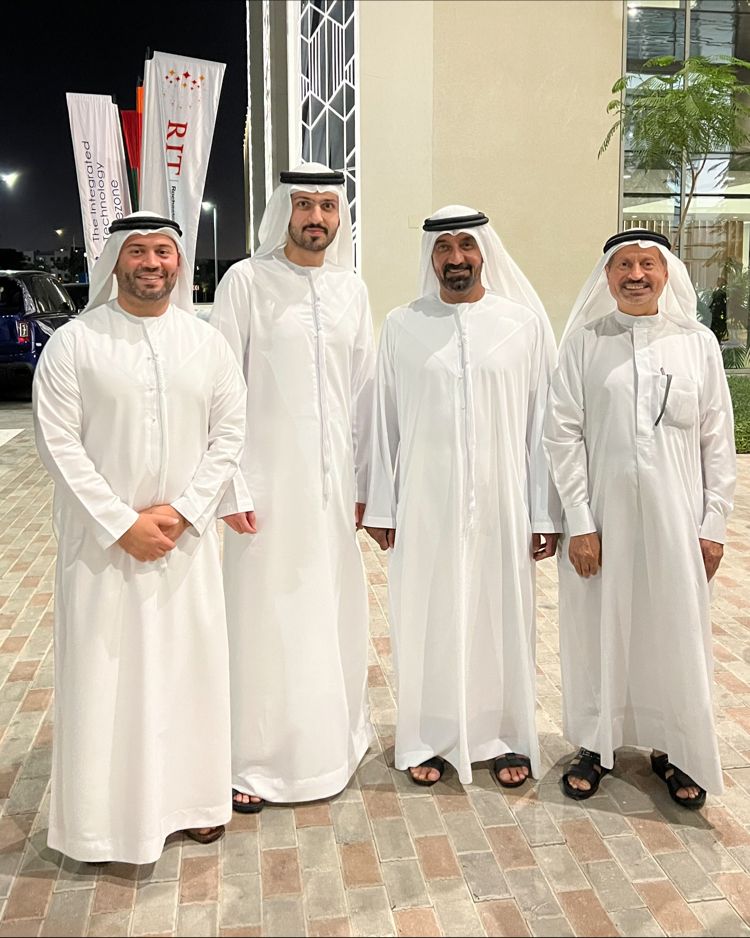
Four Emirati businessmen in traditional dress standing together at an evening business event in the United Arab Emirates
An evening business gathering in the United Arab Emirates — the commercial setting in which the company was established and grown.

2008 is not a neutral year to found a property developer. It is the year the global financial crisis reached real estate markets, and Dubai’s contraction was among the sharpest anywhere. A company begun at that point starts without the tailwind that later entrants took for granted.

The choice of name signals the intent behind it. Naming the company for his father rather than for himself frames the venture as something to be passed on. Binghatti’s own account is explicit: the name was chosen to perpetuate the brand legacy across generations.

From that founding, the portfolio grew to more than 90 projects with a stated value of $27 billion — the figure Forbes attributes to Binghatti Holding. Throughout, the founder’s ownership stayed at 100 per cent.

Significance A brand named for the previous generation, founded in the worst year available, and never diluted.

VI

2022 – 2025

Branded towers, and access to public capital

The most visible phase of the company he founded runs through the 2020s. In November 2022, Binghatti announced a collaboration with the jeweller Jacob & Co to build what was intended to be the tallest residential building in the world, in Business Bay, Dubai; work on Burj Binghatti began in October 2022. Bugatti Residences was announced in 2022, with construction starting in March 2023. Mercedes-Benz Places by Binghatti followed as a third branded development.

Alongside the towers came a change in how the business is funded. Binghatti issued its debut US-dollar sukuk in 2024, and in August 2025 issued a further $500 million sukuk listed on both Nasdaq Dubai and the London Stock Exchange. The company’s chief executive, Katralnada Binghatti, is credited with leading that listing programme.

VII

Current

Founder and owner; the chair passes on

The present stage is a deliberate change of role rather than a retirement. Forbes Middle East describes Hussain Binghatti Aljbori as the founder and former chairman of Binghatti, still holding the company at 100 per cent, with his son Muhammad Binghatti now serving as chairman.

The wider leadership follows the same pattern. Ahmed Binghatti is vice-chairman with responsibility for financial expansion. Katralnada Binghatti is chief executive. The founder’s position is that of owner — the party with everything at stake and none of the daily operating responsibility.

It completes the intention set at the founding. A company named for the generation before him is now run by the generation after him.

Next

From the sequence to the buildings themselves